Healthy Performance Marketer vs Unhealthy Performance Marketer — The Hidden Factor Behind Real Marketing Results
There’s a quiet truth most performance marketers don’t talk about.
Campaigns don’t fail only because of bad creatives, weak funnels, or wrong targeting.
Sometimes, they fail because the person behind the dashboard is running on low energy, poor focus, and burnout.
In a field where decisions are made every minute — budgets, bids, creatives, testing — your physical and mental state directly shapes your marketing performance.
And yet, the industry normalizes 10+ hour sitting, late-night campaign checks, and junk food as fuel.
That tradeoff doesn’t stay invisible for long.
The Reality of Performance Marketing Lifestyle
Performance marketing is not just a technical job — it’s a cognitive endurance game.
You’re constantly:
- Analyzing data
- Making rapid decisions
- Testing hypotheses
- Managing pressure from ROI expectations
Now combine that with:
- Sitting 8–12 hours daily
- High caffeine intake
- Irregular meals
- Low physical activity
That’s where the real problem begins.
According to World Health Organization, physical inactivity is one of the leading risk factors for global mortality — and desk-based jobs are a major contributor.
Healthy vs Unhealthy Performance Marketer (Real Comparison)
⚡ Energy & Focus
Healthy Marketer:
- Sustains focus for long periods
- Makes clear, logical decisions
- Handles campaign volatility calmly
Unhealthy Marketer:
- Brain fog during analysis
- Slower decision-making
- Emotional reactions to performance drops
👉 Performance marketing punishes slow thinking. Every delay costs money.
📊 Data Interpretation Quality
Healthy Marketer:
- Spots patterns quickly
- Thinks strategically
- Avoids over-optimization
Unhealthy Marketer:
- Gets overwhelmed by dashboards
- Misses key insights
- Relies on guesswork
👉 When your brain is tired, you don’t analyze — you react.
🚀 Creative Strategy & Testing
Healthy Marketer:
- Generates better ad angles
- Thinks outside the box
- Tests with clarity
Unhealthy Marketer:
- Repeats same creatives
- Lacks innovation
- Avoids experimentation
👉 Creativity is energy-dependent — not just skill-based.
⏱️ Productivity Over Time
Here’s where the real difference shows.
📊 Performance Impact Comparison
| Metric | Healthy Marketer | Unhealthy Marketer | Source |
|---|---|---|---|
| Average focus span | 90–120 mins | 20–40 mins | Stanford Research |
| Decision accuracy | +25% higher | Lower under fatigue | Harvard Business Review |
| Productivity drop (fatigue) | Minimal | Up to 30% loss | McKinsey |
| Error rate in tasks | Lower | Significantly higher | Journal of Occupational Health |
| Long-term burnout risk | Low | High | WHO |
👉 The difference compounds over weeks — and shows directly in campaign results.
The Long Sitting Trap (The Silent Killer of Marketers)
At the start of your career, long sitting feels productive.
You’re:
- Learning fast
- Working harder than others
- Scaling campaigns
But over time:
- Energy drops
- Weight increases
- Focus weakens
- Motivation declines
This isn’t theory — it’s a pattern seen across agencies, freelancers, and in-house teams.
👉 You don’t notice the drop — until your performance starts slipping.
Junk Food & Cognitive Decline
Let’s be direct.
Most performance marketers rely on:
- Fast food
- Sugary drinks
- Processed snacks
Short-term effect:
- Quick energy spike
Long-term effect:
- Energy crashes
- Reduced concentration
- Increased fatigue
Research from Harvard Medical School shows that diets high in processed foods can negatively impact memory and cognitive function.
👉 You can’t optimize campaigns if your brain is running on poor fuel.
Real Impact on Marketing Results
This is where everything connects.
An unhealthy marketer leads to:
- Poor budget allocation
- Delayed optimization decisions
- Missed scaling opportunities
- Higher CPA
- Lower ROAS
While a healthy marketer:
- Spots winning ads faster
- Scales confidently
- Cuts losses early
- Maintains consistency
👉 The same strategy, in different physical states, produces different results.
The Productivity Illusion
Many marketers believe:
“More hours = better results”
Reality:
- After a certain point, productivity declines
- Mistakes increase
- Creativity drops
👉 A 6-hour focused marketer often outperforms a 12-hour exhausted one.
What Actually Works (Practical Shift, Not Motivation)
You don’t need a complete lifestyle overhaul.
You need small, sustainable changes:
✅ Movement
- 5–10 minute walk every hour
- Standing desk (if possible)
✅ Nutrition
- Replace 1 junk meal daily
- Increase water intake
✅ Work Blocks
- 60–90 minute deep work sessions
- Breaks without screens
✅ Sleep
- Non-negotiable for decision-making quality
👉 This isn’t about fitness — it’s about performance.
A Shift Most Marketers Ignore
The industry talks about:
- AI tools
- Ad strategies
- Platform updates
But ignores the operator behind the system.
That’s the gap.
And those who fix it quietly outperform others.
A Smarter Way to Level Up
If campaigns feel harder than they should, don’t just audit your ads.
Audit yourself.
Start noticing:
- When your focus drops
- How your energy affects decisions
- What your daily habits look like
That awareness alone changes how you work.
If You’re Serious About Growth
There’s a deeper layer to performance marketing most people miss.
Not just tools. Not just tactics.
How you operate daily decides how your campaigns perform.
That’s where real improvement begins.
Common Questions Marketers Ask
What is the biggest health risk for performance marketers?
Long sitting combined with poor diet. It directly affects energy, focus, and long-term productivity.
How does health affect marketing performance?
It impacts decision-making, creativity, and analytical ability — all core to performance marketing success.
Can poor health really reduce ROAS?
Yes. Slower decisions, missed insights, and fatigue can lead to inefficient ad spend and lower returns.
How many hours should a performance marketer work?
Focused 6–8 hours outperform long unproductive 10–12 hour workdays.
What’s the easiest habit to start improving performance?
Short breaks and reducing junk food intake. These have immediate impact on energy and focus.
About the Author
Mohsin Ali writes from real experience inside performance marketing — not theory. Having worked closely with campaigns, data, and the daily grind of digital growth, he understands what actually moves results.
More importantly, he focuses on the human side of performance — the part most marketers ignore.
You can connect or learn more here:
https://mohsinaligs.com/about
https://mohsinaligs.com/contact

Mohsin Ali
Publishing practical ideas, sharp strategies, and useful insights for growing modern digital brands.
Related Stories
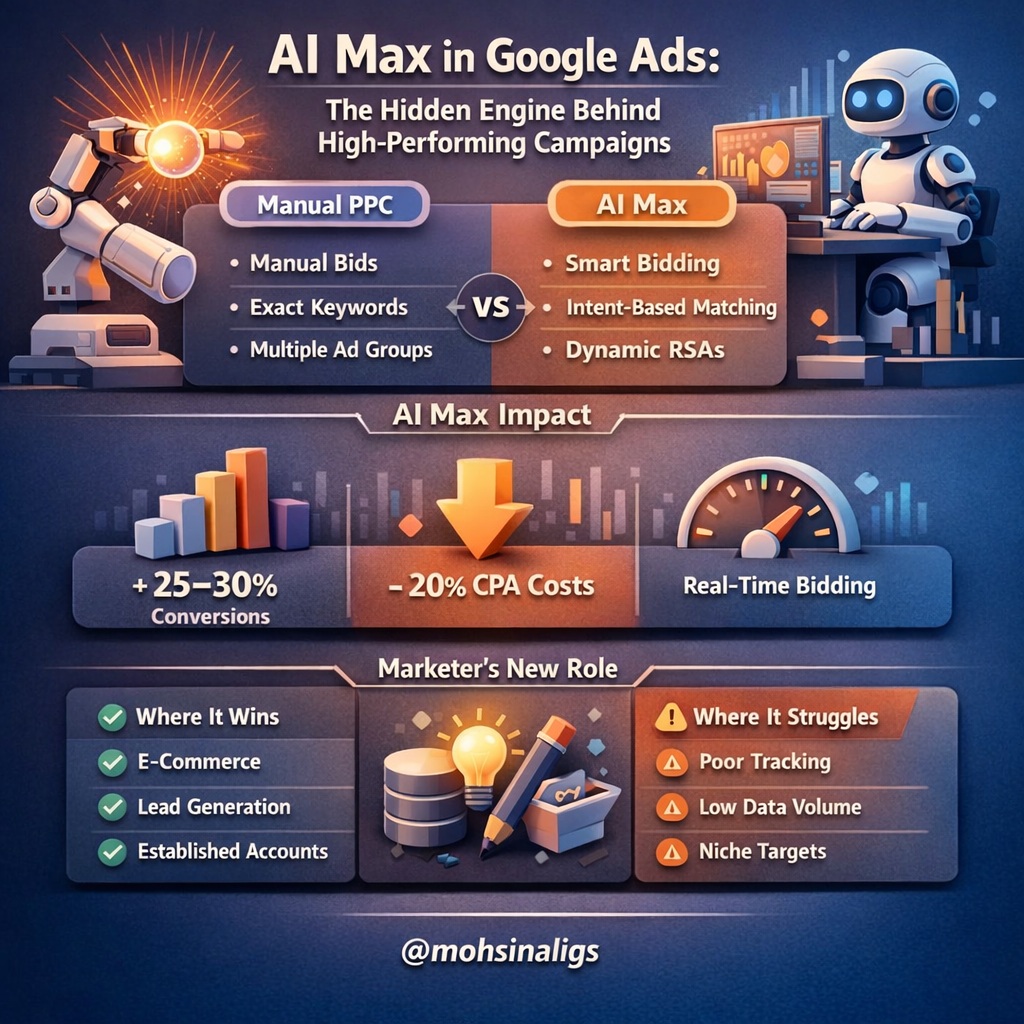
AI Max in Google Ads: The Hidden Engine Behind High-Performing...
Something changed quietly inside Google Ads—and most advertisers didn’t even notice it happening. Campaigns that used to require...
Read More
Andromeda Algorithm Meta Ads: The Silent Shift Changing Performance Marketing
The biggest changes in advertising rarely come with announcements — they show up in performance graphs. That’s exactly...
Read More
TikTok Ads vs Meta Ads for eCommerce: Where Real Growth...
The biggest mistake I still see in eCommerce isn’t bad products — it’s choosing the wrong traffic engine....
Read More
 Chat on WhatsApp
